Translate:
 
Web This Site

Sunday, December 25, 2005 

Ananova: Wife wants divorce for virtual adultery

A Romanian woman demanded a divorce for virtual adultery after she caught her husband surfing the internet for porn.

Geta M, 45, from Galati, has been married to her husband Ion for 23 years but told the court she couldn't go on because she felt cheated.

She admitted Ion was a good husband, coming home on time and taking care of the family, but she says she couldn't accept being replaced by 'virtual lovers'.

Geta told the court: "When I caught him watching porn movies and looking to pictures of naked women I knew I had to divorce.

"What he does is totally away from my principles of life and I don't want to be near him when he does that. I want to set him free so he could find himself the woman he likes."

Ion said he found himself tempted by the XXX images after he bought his younger son a new computer and accessed the internet.

He said he doesn't want to separate from his wife and the court decided to give the woman time to reconsider her demand, reported the 7 Plus newspaper.

Originally posted at: Ananova


Thursday, December 22, 2005 

An end to Women's periods

A new contraceptive will soon let women stop menstruating. Is it the pinnacle of liberation, or a reckless experiment?

By: LIANNE GEORGE

For the average woman, life holds not two but three certainties: death, taxes and 35 years of monthly hormonal mayhem. Periods can be wretched. But from a young age, girls are comforted with the promise that the bleeding, cramping and radical mood swings are all part of the special alchemy of womanhood. Menstruation is -- to use the mother of all feminine-hygiene euphemisms -- a precious gift. Which is why the introduction of a new product that invites women to opt out of the whole ordeal is something of a cultural upheaval. Health experts are predicting that by this time next year, menstruation will no longer be an inevitable function but rather an optional feature, a bit like power steering or pay-per-view.

In 2006, a new oral contraceptive called Anya, developed to "put women in control of when or if they want to menstruate," is expected to hit the Canadian and U.S. markets. Manufactured by Collegeville, Penn.-based Wyeth Pharmaceuticals -- and currently pending approval by Health Canada -- Anya is the first low-dose birth control pill designed to be taken 365 days a year, without placebos (the hormone-free sugar pills taken at the end of every 28-day cycle). Early findings report that Anya is just as effective in preventing pregnancy as traditional oral contraceptives (98 per cent). And as an added bonus, since Anya provides a steady stream of hormones, it promises to quash a woman's usual cyclical fluctuations, virtually wiping out all the irksome symptoms of PMS. read more...


Tuesday, December 20, 2005 

History: 15 years of the World Wide Web

From CNN's Kristie Lu Stout

(CNN) -- Spark looks at the top 10 "Web moments" since the World Wide Web was born 15 years ago, and asks viewers to vote for the one they think had the most impact in the Web's history.

In 1990, Tim Berners-Lee launched the World Wide Web, a multimedia branch of the Internet.

With Berners-Lee's "http protocol," computer jockeys the world over began making the Net easier to use with point-and-click programs.

Browsers such as Mosaic and, later, Netscape Navigator would help popularize the Web, and let a billion Web pages bloom.

Anyone could access the network, and anyone could decide what went online.

The Web became a powerful, liberating force that brought people closer together, and shaped new businesses.

Take Yahoo, which started as a quirky list favorite links that turned into the go-to site of the 90s.

Or Hotmail, one of the first Web services to give away e-mail for free.

And Ebay, which linked up buyers and sellers of nearly everything to become the world's biggest trading post.

And of course Amazon, the online behemoth of books.

These were the great companies of the so-called "new economy," fueled by venture capitalist sugar daddies and excitable Nasdaq punters.

But with every dot-com blue chip, there were the dogs as well -- think of the likes of Pets.com and Globe.com.

It all looked a bit too bubbly -- long on vision and way short on fundamentals. But today, the blue chips are still standing -- taller than ever.

Amazon is well in the black and has proved cyber-retailing is big business, online advertising is pulling in profits at Yahoo and eBay has become an economy in its own right, with millions of users set to trade goods worth more than $40 billion this year.

But it is Google that gets the most attention. It is the Goliath of the Web, with search, e-mail, e-commerce, instant messaging, classified ads, and even its own virtual planet with Google Earth -- all adding up to one mega-market cap.

The Web is a thrill ride yet again. It is bigger. It is faster. And the original spirit of community-building is still there.

Myspace -- a virtual hangout for wired teens -- has seen its membership rise to 40 million in the last year, prompting News Corp to pick up its parent for more than half a billion dollars.

Skype is the new Hotmail -- linking millions of callers, turning the telecom market upside down, and attracting a $2.6 billion buy-out from eBay.

Yahoo, meanwhile, swooped in on Flickr -- the service that has transformed photography into a popular social pursuit.

The second boom is well underway. So watch this space. This may be a cyber-sequel built to last.

Spark's top 10 Web moments

These are Spark's picks as the top 10 moments in the World Wide Web's short but impressive life. Vote for the one you think is the most significant, or read what others say:

10. WiFi hotspots -- wireless Internet connectivity appears in airports, hotels and even McDonald's.

9. Webcams and photo sharing -- communication becomes visual, and inboxes fill with baby photos.

8. Skype -- telephony turns upside down with free long-distance calls, Ebay snaps it up in September 2005 for $2.6 billion.

7. Live 8 on AOL -- five million people watch poverty awareness concerts online in July 2005, setting a new Net record.

6. Napster goes offline -- Regulators close the pioneering music swap site in July 2001 and file-sharing goes offshore.

5. Lewinsky scandal -- Matt Drudge breaks the Clinton/Lewinsky sex scandal in 1998. The blog is born.

4. Tsunami and 9/11 -- two tragic events set the Web alight with opinion and amateur video.

3. Boom and bust -- trillions of dollars were made and lost as the dotcom bubble ballooned and burst between 1995 and 2001.

2. Hotmail -- went from having zero users in 1995 to 30 million subscribers 30 months later. It now has 215 million users.

1. Google -- redefined search. Invented a new advertising model and commands a vast business empire.



 

Anti-Hacking Tools’ Maker Gets Hacked

We can certainly say that hackers are the plague of today's Internet. I’m not necessarily talking about "old-school" hackers who do something just to see if they can, and then warn their targets about the found vulnerabilities, but about those who carry out such actions in order to obtain certain advantages (usually, material) from their actions.
These evil tech-geniuses have gotten so good lately, that they are even able to hack into the heart of the enemy, namely companies developing various security tools, without being immediately discovered.

And, according to CNET News, that’s exactly what happened at Guidance Software, one of the leading sellers of software used to investigate computer crimes, sent out letters last week to inform its customers of the fact that a hacker broke in and accessed records, including credit card data.

Even if this breach occurred in November, but wasn't discovered until Dec. 7, said John Colbert, chief executive officer of Guidance. The attack left for grabs the data regarding some thousands of the company's customers, including 3,800 whose names, addresses and credit card details.
Guidance's EnCase software is used by security researchers and law enforcement agencies worldwide. The Pasadena, Calif.-based company notified all its approximately 9,500 customers about the attack and has called in the U.S. Secret Service, which has started an investigation, Colbert said.

It seems that the hacker behind this attack has already started to use the stolen information, since New York City-based Kessler International, who received notice from Guidance on Monday, did so three days after it got an American Express bill for about $20,000, mostly in unauthorized charges for advertising at Google, said Michael Kessler, president of the computer-forensics investigative firm.

Well, considering the fact that this is the last in a series of spectacular security breaches that occurred this year, I think that companies, especially those who store very sensitive customer information, should really be a lot more careful with their security systems. Otherwise, the customer’s level of trust in their services will plummet, and so will their profits.

Orignally posted at: http://www.playfuls.com/itnews_456.html
=========================

this news is ironic.. a security company that can't even protect themselves.. so, would you trust your data with them?


Tuesday, December 13, 2005 

Youngest Mother

Claim: The youngest mother on record was a five-year-old Peruvian girl.

Status: True.

Origins: Although we can see a tremendous amount of variety in the plant and animal life all around us — both within and between species — many of us still find extremes in variety among human beings somewhat disconcerting. While an extraordinarily large dog or a cat with an unusually long tail may be regarded as nothing more than a momentarily interesting curiosity or a source of amusement, people who exhibit one of the extremes in human development — whether it be in intelligence, height, weight, or some other feature — have long struggled to avoid being identified as "freaks."

Perhaps the most discomfiting record of this nature involves the youngest person ever to give birth, reputedly a five-year-old girl — not only because such a record posits that a child barely of kindergarten age (presumably involuntarily) underwent an experience we associate with physical and psychological maturity, but also because it implies the commission of an act now considered to be nothing less than child molestation.

Regardless of our squeamishness, we have to note that the claim of a five-year-old girl giving birth is apparently true. Her name was Lina Medina, a Peruvian girl from the Andean village of Ticrapo who made medical history when she gave birth to a boy by caesarean section in May 1939 at the age of five years, seven months and 21 days. Lina's parents initially thought their daughter had a large abdominal tumor, but after they took her to a hospital in the town of Pisco physicians confirmed that her abdominal swelling was due to pregnancy. Lina was eventually transferred to a hospital in Lima, where she delivered a six-pound baby boy by Cesarean section on 14 May 1939 (coincidentally the date on which Mother's Day was celebrated that year). Lina's father was temporarily jailed on suspicion of incest, but he was released for a lack of evidence and authorities were never able to determine who fathered Lina's child.

Lina's incredible story was documented in contemporaneous reports by Edmundo Escomel, one of Peru's preeminent physician-researchers of the period and a laureate of the prestigious French Academy of Sciences. Escomel's first correspondence to the editors of La Presse Medicale1 (which is undated but appeared in the 13 May 1939 issue) noted that Lina first came to the attention of Dr. Gérado Lozada, chief physician of the Hospital of Pisco, when she appeared at that hospital in early April 1939 for evaluation of what was assumed to be a massive abdominal tumor.

It soon became obvious to the stunned Lozada, however, that the little girl was pregnant. A medical history revealed that she had been having regular periods since age 3, but that she had stopped menstruating for the past 7½ months. Additionally, she had fully developed breasts. Further examination revealed a fetal heartbeat, and an X-ray confirmed the pregnancy. Escomel stated that Lozada had submitted a report about the case to the Academy of Medicine in Lima.

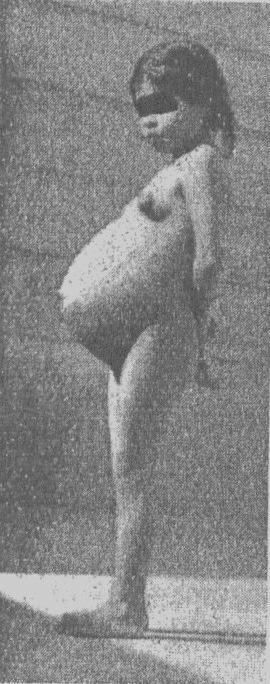
Escomel's announcement2 (dated 20 May 1939) that Lina had delivered a baby boy (on 14 May) appeared in the 31 May issue of La Presse Medicale. In addition to amending the age at which Lina began menstruating (to an incredible 8 months), Escomel submitted a photograph of the gravid 5½-year-old:

Lina Medina

At the end of his piece Escomel noted with some sadness that no one had yet discovered the identity of the father since Lina "couldn't give precise responses." He also stressed the importance of getting adequate care for the little girl.

Escomel's final report3 was published in the 19 December 1939 issue of La Presse Medicale. He commented on a biopsy of one of Lina's ovaries performed on a sample removed at the time of the Cesarean section and provided photomicrographs of the stained tissue sections. In the end, pathologists pronounced Lina to have the ovaries of a fully mature woman. Escomel posited that the reason behind her precocious fertility could not lie in the ovaries themselves but must have stemmed from an extraordinary hormonal disorder of pituitary origin. (As a point of comparison, the average age of first menstruation in the U.S. is 12½.)

The U.S. press was also interested in this curious and disturbing story. A United Press report published in the Los Angeles Times on 16 May 1939 noted:
Dr. Hipolito Larrabure, head of the maternity hospital, who aided Dr. [Geraldo] Lozada [director of the Pisco Hospital] during the [Cesarean] operation, said Lina withstood the operation in excellent manner. Medical circles here were astonished at the birth, which they believed without precedent. Dr. Larrabure said the case was "truly astounding" and added that he hoped "some United States scientific foundation will send an investigator to Lima to observe the case and indicate the best manner of caring for the mother and child."4
The Los Angeles Times also reported their own confirmation of the story that same day:
The possibility of a girl becoming a mother at the age of 5, as reported on Sunday from Lima, Peru, was upheld today by Dr. Joseph B. De Lee, obstetrics authority of Chicago Lying-in Hospital.

Dr. De Lee cited the case of a Russian girl who became a mother at the age of 6½. According to the physician who reported the case in a German medical journal, Dr. De Lee said, the mother had the physical development of a girl 10 or 12 years old.5
Six months later, the New York Times reported that an American public health official had also verified Lina's remarkable story:
While in Lima Dr. [S.L. Christian, assistant surgeon general of the U.S. Public Health Service] examined Lina Medina, the Indian child-mother whose baby was born last May when the mother was about 5 years old. He said that although there was some confusion as to whether the mother was 5 or 6, there was no doubt of the authenticity of the case, which he described as the most amazing thing in his career as a physician.6
The following year the New York Times reported that a trip was being organized so Lina could be "brought to the United States within a month for examination by a five-man medical commission." Plans called for the little mother, the baby boy, and the girl's parents to travel to Chicago, but there was no follow-up indicating that the Medina family ever made the journey to the U.S.7 In 1941, two years after Lina give birth, the New York Times published an account of an American psychologist who had examined Lina while visiting South America:
Another passenger [on the liner Santa Clara, which was returning from South America] was Mrs. Paul Kosak, specialist in child education at Teachers College, Columbia University. Mrs. Kosak is the only child psychologist who has been permitted to make studies of Lina Medina, the Peruvian girl who, two years ago, gave birth to a child at the age of 5 years.

Mrs. Kosak said she gave a series of intelligence tests to the child and that on the basis of this study she has no doubt the child's age was given correctly.

"Lina is above normal in intelligence and the baby, a boy, is perfectly normal and is physically better developed than the average Mestiza (Spanish Indian) child," she said. "She thinks of the child as a baby brother and so does the rest of the family."8
Lina Medina
Lina Medina, son Gerardo,
and Dr. Gérado Lozada

Jose Sandoval, an obstetrician who took an interest in Lina Medina's case and authored a book about her in 2002 said that Lina was a psychologically normal child, that she displayed no other unusual medical symptoms, and that she preferred playing with dolls rather than her own child.

Lina's boy, named Gerardo (after Dr. Gérado Lozada, chief physician of the hospital in Pisco where Lina's pregnancy was diagnosed), did not learn until he was 10 years old that the woman he thought to be his sister was in fact his mother. Gerardo died in 1979, but Lina's second son, born in 1972 (thirty-three years after his brother), now lives in Mexico. Lina and her husband currently reside in the "Little Chicago" district of Lima, Peru.

Orignall Posted at: http://www.snopes.com/pregnant/medina.asp


Monday, December 12, 2005 

A Little Sleuthing Unmasks Writer of Wikipedia Prank

Published: December 11, 2005

It started as a joke and ended up as a shot heard round the Internet, with the joker losing his job and Wikipedia, the online encyclopedia, suffering a blow to its credibility.

A man in Nashville has admitted that, in trying to shock a colleague with a joke, he put false information into a Wikipedia entry about John Seigenthaler Sr., a former editor of The Tennessean in Nashville.

Brian Chase, 38, who until Friday was an operations manager at a small delivery company, told Mr. Seigenthaler on Friday that he had written the material suggesting that Mr. Seigenthaler had been involved in the assassinations of John and Robert Kennedy. Wikipedia, a nonprofit venture that is the world's biggest encyclopedia, is written and edited by thousands of volunteers.

Mr. Seigenthaler discovered the false entry only recently and wrote about it in an op-ed article in USA Today, saying he was especially annoyed that he could not track down the perpetrator because of Internet privacy laws. His plight touched off a debate about the reliability of information on Wikipedia - and by extension the entire Internet - and the difficulty in holding Web sites and their users accountable, even when someone is defamed.

In a confessional letter to Mr. Seigenthaler, Mr. Chase said he thought Wikipedia was a "gag" Web site and that he had written the assassination tale to shock a co-worker, who knew of the Seigenthaler family and its illustrious history in Nashville.

"It had the intended effect," Mr. Chase said of his prank in an interview. But Mr. Chase said that once he became aware last week through news accounts of the damage he had done to Mr. Seigenthaler, he was remorseful and also a little scared of what might happen to him.

Mr. Chase also found that he was slowly being cornered in cyberspace, thanks to the sleuthing efforts of Daniel Brandt, 57, of San Antonio, who makes his living as a book indexer. Mr. Brandt has been a frequent critic of Wikipedia and started an anti-Wikipedia Web site (www.wikipedia-watch.org) in September after reading what he said was a false entry about himself.

Using information in Mr. Seigenthaler's article and some online tools, Mr. Brandt traced the computer used to make the Wikipedia entry to the delivery company in Nashville. Mr. Brandt called the company and told employees there about the Wikipedia problem but was not able to learn anything definitive.

Mr. Brandt then sent an e-mail message to the company, asking for information about its courier services. A response bore the same Internet Protocol address that was left by the creator of the Wikipedia entry, offering further evidence of a connection.

A call by a New York Times reporter to the delivery company on Thursday made employees nervous, Mr. Chase later told Mr. Seigenthaler. On Friday, Mr. Chase hand-delivered a letter to Mr. Seigenthaler's office, confessing what he had done, and later they talked at length.

Mr. Chase told him that the Seigenthaler name had come up at work and that he had popped it into a search engine and was led to Wikipedia, where, he said, he was surprised that anyone could make an entry.

Mr. Chase wrote: "I am truly sorry to have offended you, sir. Whatever fame comes to me from this will be ill-gotten indeed."

Mr. Seigenthaler said Mr. Brandt was "a genius" for tracking down Mr. Chase. He said he "was not after a pound of flesh" and would not take Mr. Chase to court.

Mr. Chase resigned from his job because, he said, he did not want to cause problems for his company. Mr. Seigenthaler urged Mr. Chase's boss to rehire him, but Mr. Chase said that, so far, this had not happened.

Mr. Chase said that as Mr. Brandt and the news media were closing in and he realized how much he had hurt Mr. Seigenthaler, he decided that stepping forward was "the right thing to do."

Mr. Seigenthaler, founder of the First Amendment Center, said that as a longtime advocate of free speech, he found it awkward to be tracking down someone who had exercised that right.

"I still believe in free expression," he said. "What I want is accountability."

Jimmy Wales, who founded Wikipedia, said that the site would make more information about users available to make it easier to lodge complaints. But he portrayed the error as something that fell through the cracks, not a sign of a systemic problem. "We have to continually evaluate whether our controls are enough," he said.


Sunday, December 11, 2005 

Be Scared: Court Rules Against Mom in Download Suit

By TED BRIDIS, Associated Press Writer Fri Dec 9, 8:58 PM ET

WASHINGTON - A federal appeals court late Friday upheld the music industry's $22,500 judgment against a Chicago mother caught illegally distributing songs over the Internet.

The court rejected her defense that she was innocently sampling music to find songs she might buy later and compared her downloading and distributing the songs to shoplifting.

The decision against Cecilia Gonzalez, 29, represents one of the earliest appeals court victories by the music industry in copyright lawsuits it has filed against thousands of computer users. The three-judge panel of the U.S. Court of Appeals for the Seventh Circuit in Chicago threw out Gonzalez's arguments that her Internet activities were permitted under U.S. copyright laws.

Gonzalez had rejected a proposed settlement from music companies of about $3,500. A federal judge later filed a summary judgment against her and ordered her to pay $750 for each of 30 songs she was accused of illegally distributing over the Internet.

Gonzalez, a mother of five, contended she had downloaded songs to determine what she liked enough to buy at retail. She said she and her husband regularly buy music CDs and own more than 250.

However, the appeals panel said Gonzalez never deleted songs off her computer she decided not to buy, and judges said she could have been liable for more than 1,000 songs found on her computer.

"A copy downloaded, played, and retained on one's hard drive for future use is a direct substitute for a purchased copy," the judges wrote. They said her defense that she downloaded fewer songs than many other computer users "is no more relevant than a thief's contention that he shoplifted only 30 compact discs, planning to listen to them at home and pay later."

Gonzalez could not be reached for comment. Her lawyer, Geoff Baker, said comparing Gonzalez to a shoplifter was "inflammatory" but declined to comment further until he had more time to review the decision, which was released late in the day.

Gonzalez was named in the first wave of civil lawsuits filed by record companies and their trade organization, the Recording Industry Association of America, in September 2003.


"The law here is quite clear," said Jonathan Lamy, a senior vice president for the Washington-based RIAA. "Our goal with all these anti-piracy efforts is to protect the ability of the music industry to invest in the bands of tomorrow and give legal online services a chance to flourish."

=============================

mmm, I miss the good ol Napster days.. the days when you can download and share your favorite music without fear of being sued by the RIAA.. I'm a music lover myself, and have a great deal of music collection.. but I'm selfish now.. no file sharing.. be scared.. be very scared..


Friday, December 09, 2005 

On-line gamer dies


A South Korean man collapsed and died from exhaustion after playing computer games for 10 days without a proper rest.

"He was carried to a nearby hospital but declared dead on arrival," a police officer told AFP.

The officer said the man had played computer games from morning to night every day and had barely stopped to sleep.

In August, a 28-year-old man died in southeastern Taegu city after playing an online computer game for more than two days.

Posted at: PHYSORG.com
===================

I've seen a lot of online gaming addicts playing 8 hours a day straight, taking only a break just to pee.. but this one is extreme... maybe we should consider online gaming as an extreme sport..


Creative Offers Alternative to Video iPod

By Bary Alyssa Johnson | Posted at PC Magazine

Creative Technology, Ltd., a company geared toward digital entertainment via PC platform, announced Thursday the most recent addition to its line of Zen Vision PMPs (portable media players).

The 30GB Zen Vision: M, which the company said it designed to give Apple's iPod some creative competition, offers a number of features including MP3 and video player, photo viewer and FM tuner.

"We designed the Zen Vision: M to display four times the color of the 30GB iPod that plays video, and to provide twice the battery life for video playback," said Sim Wong Hoo, Creative's CEO, in a statement.

The Vision: M, which includes a vertical touch pad, boasts a 2.5-inch high-res 262,144 color LCD display. The device weighs about five ounces and measures in at 4.1" x 2.4" x 0.7".

In terms of multimedia, the Vision: M PMP offers video, MP3 and photo capabilities. It also has plenty of memory for storing thousands of photos, up to 15,000 songs or 120 hours of video.

The MP3 player function allows for up to 14 hours of music playback and is compatible with MP3, WAV and WMA audio file formats. It also displays album art, according to company officials.

The player features Windows Media PlaysForSure technology, which gives users access to audio tracks via music subscription services like Yahoo Music Unlimited and Napster To Go. It also supports downloads from e-music stores including Yahoo Music, AOL Music Now, Napster and more.

The Vision: M video player offers up to four hours video playback and supports a range of video file formats, including MPEG-2, MPEG-4, MJPEG (Motion JPEG), WMV9 and compatible DivX 4, 5 and Xvid.

Users can download video files from their PC with an included USB 2.0 cable and have the option to access and view video blogs (from NYC-based Rocketboom).

The device also supports TiVo To Go, which lets users transfer and watch television shows stored on their TiVo DVR (digital video recorder), company officials said.

With Creative's Vision: M photo function, users can store and view color photos at 320 x 240 resolution.

Consumers can create and watch photo slideshows and can also add effects such as music. An optional video-out connecter lets users view single photos or entire slideshows through their TV.

The Vision: M makes available several additional features, including built-in microphone for voice recording and content password protection.

The new PMP also has a personal organizer, which can sync with Microsoft Outlook to transfer contacts, calendars and to-do lists. It also ups the ante by offering integrated FM radio with recording capability.

The Zen Vision: M is available in black, white, blue, green or pink and is slated to become available for purchase online later this month.

The player comes bundled with earphones, a power adapter, sync adapter, USB 2.0 mini-B cable and carrying pouch, and retails for $329.99.

Users can purchase a range of optional accessories such as a docking station and AV-out cable separately.

=================

I have a 20 GB iPod, but only after a month of use, the hard disk just crashed.. a big dissapointment for such a wonderful product.. maybe I'll buy Creative next time...


Thursday, December 08, 2005 

Philippines' Pinoy Big Brother suspended because of kissing, bikini dancing


The Philippines’ edition of Big Brother, known as Pinoy Big Brother, got in trouble because it showed kissing and houseguests dancing in a bikini.


The show has previously been warned “to make [the show] more wholesome.” But it crossed the line and the Movie & Television Review & Classification Board took action.

The MTRCB said in a letter that the PG rating was inappropriate because the series included “kissing scene between housemates Chx and Sam, gyrating dances in skimpy bikini, double entendre dialogue and use of skimpy bikini.” Thus, the show did not air today.

Damn. What would happen if, hypothetically, “stripped down to his underwear and [danced] about with the broom” and later “put an orange in his pants … dyed his hair blue … passed out on the lawn, and then barfed his guts out several times”? Or if a player was an unrepentant liar? Or called all the show’s viewers “pieces of shit”?


About me

  • I'm G.M.C.
  • From San Diego, California, United States
  • A computer science instructor, a die hard Linux fan, and an Open Source supporter
My profile

Sponsored Links


    Get Chitika eMiniMalls
Powered by Blogger
and Blogger Templates